


Heat Pumps Drive Airport Decarbonization Goals
Inside the air-source and groundwater systems at SEA and PDX
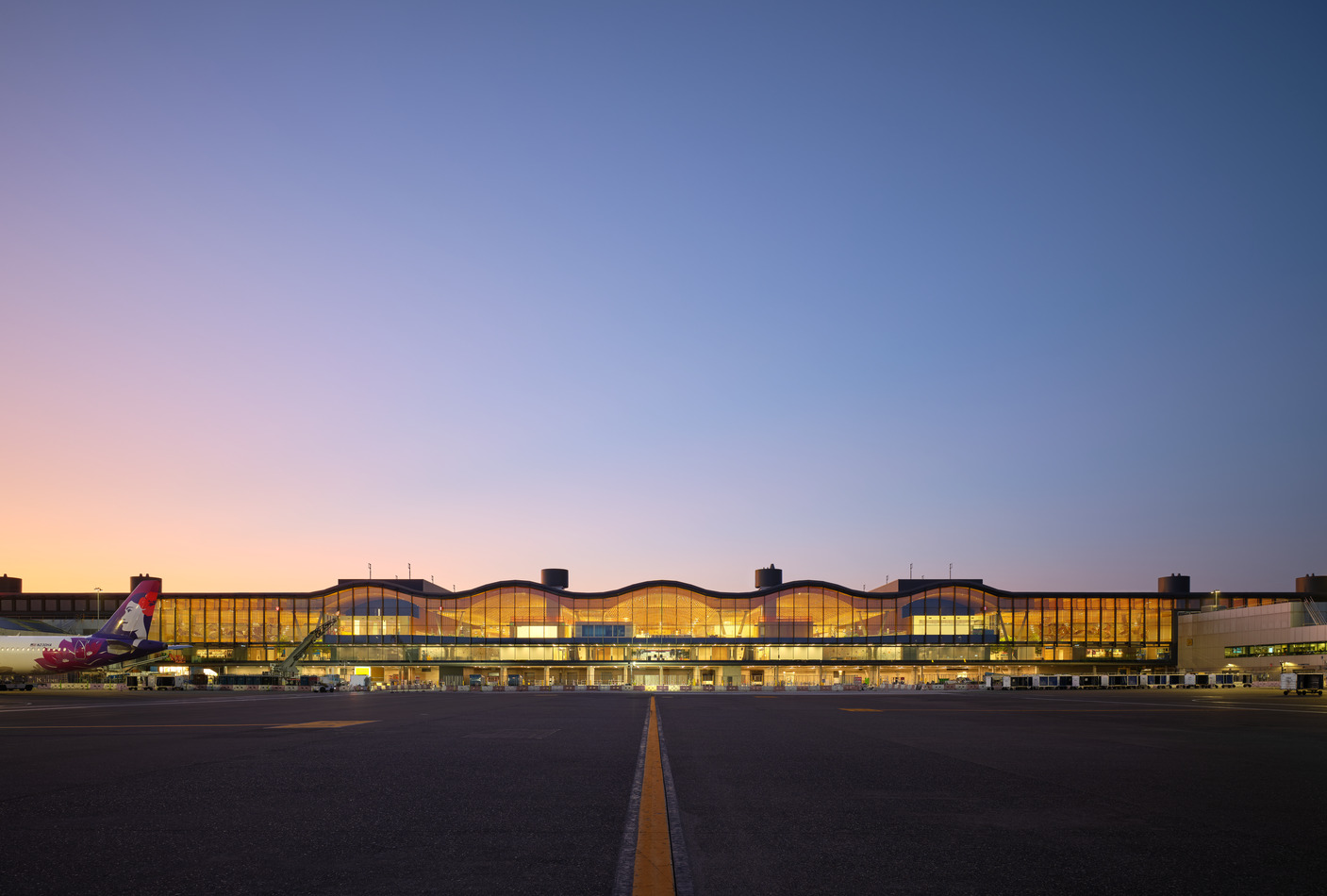
Airports around the world are transforming. They're not just adding flight and passenger capacity, but improving the experience: more natural light, better Wi-Fi, and if we're lucky, maybe even quicker trips through security. But most impactful of all are arguably the changes we can't see.
From Amsterdam to Auckland, Beijing to Brussels—and here in the Pacific Northwest—airports are finding ways to decarbonize their buildings, improve energy efficiency, and reduce their reliance on fossil fuels.
At Seattle-Tacoma International Airport (SEA) and Portland International Airport (PDX), PAE and its partners have helped advance those goals using two very different heat pump strategies.
At SEA, the C Concourse Expansion uses a decentralized air-source heat pump as part of the Port of Seattle’s first all-electric project. At PDX, the transformed main terminal relies on a centralized groundwater heat pump system designed to dramatically reduce energy use.
Why two different approaches? Because when it comes to decarbonizing complex existing infrastructure, there isn’t one answer. The right system depends on the building, site, climate, economics, and operational requirements.
SEA: Electrifying a New Concourse
The expansion of Seattle-Tacoma International Airport’s C Concourse, overseen by architect partners Miller Hull and Woods Bagot, pairs a transformed passenger experience with ambitious sustainability goals. Natural light, locally sourced Western Hemlock, electrochromic glass, rooftop photovoltaic panels, and all-electric restaurant kitchens all contribute to reducing the project’s carbon footprint.
Central to those efforts is a decentralized air-source heat pump.
The challenge: Decarbonize while maintaining resilience
SEA Airport has historically relied on a central steam plant powered by natural gas. Replacing the entire plant would have come at a prohibitive cost. For the C Concourse Expansion, however, the Port of Seattle had an opportunity to take a different approach. Rather than extending fossil-fuel-dependent heating to the new space, an air-source heat pump could reduce the airport’s overall use of fossil fuels while also taking pressure off the central plant.
And there was another advantage: the existing steam system could remain in place as backup.
Decarbonization didn’t require replacing everything. The new heat pump could work alongside existing airport infrastructure.
Lastly, the solution had to meet another non-negotiable requirement: passenger comfort. For that reason, PAE joined the project early in conceptual design to evaluate sustainability measures, efficiencies, costs, maintenance implications, and operational requirements. That analysis also considered how the heat pump could work alongside rooftop photovoltaics and a highly energy-efficient building envelope.
Why heat pumps?
Heat pumps are a highly efficient way to heat all-electric buildings. Instead of creating heat directly from electricity, they use electricity to move heat from one place to another.
That makes a big difference in energy use. For every kilowatt of electricity consumed, a heat pump can deliver roughly 3 to 5 kilowatts of heat. A conventional electric resistance heater, by comparison, delivers about 1 kilowatt of heat for every kilowatt of electricity it uses.
At SEA, the team determined that heat pumps would provide the greatest benefit for heating, not cooling. The airport already had a central cooling system that could handle cooling efficiently, and there were few times when the airport needed significant heating and cooling at the same time—limiting the opportunity to capture and reuse excess heat.
The result was a practical hybrid approach: use heat pumps where they provide the biggest efficiency gains, while continuing to use existing systems where they already work well.
Why air source?
The team considered several types of heat pumps before selecting the best fit for the C Concourse.
One option was a ground-source heat pump, which uses the relatively stable temperature underground as a source of heat. These systems can be highly efficient, but they require an extensive network of underground piping.
For the C Concourse, installing that piping wasn’t practical. The expansion was being built within the footprint of the existing building, including two below-grade floors that would remain in place. Adding the underground infrastructure would have required significant work outside the project’s scope and would have been prohibitively expensive.
An air-source heat pump offered a much better fit. Instead of drawing heat from the ground, it extracts heat from the outdoor air (even when it’s cold outside) and uses that heat to warm the building.
The Pacific Northwest’s relatively mild climate also makes air-source technology a good match. The region generally avoids prolonged periods of extreme cold, when heat pumps have to work harder, as well as extended periods of intense heat and humidity.
In short, air source offered the efficiency benefits of a heat pump without the cost and construction challenges of installing a ground-source system.
Combining systems strategically
SEA’s C Concourse shows that making a building more sustainable doesn’t always mean replacing every existing system. Sometimes, the best approach is to combine new technology with infrastructure that is already working well.
At the C Concourse, the air-source heat pump is part of a broader strategy that includes a highly efficient building envelope, rooftop solar panels, all-electric kitchens, and portions of the airport’s existing heating and cooling infrastructure.
Together, these strategies are helping the C Concourse Expansion pursue LEED Platinum, the highest level of certification in the U.S. Green Building Council’s LEED green building rating system.
Making all of these systems work together required careful planning, especially when connecting the new heat pump with the airport’s existing centralized systems.
But the project also points to a broader lesson: when carbon-reduction goals are established early, they can shape major design decisions rather than being added on later. That can create more opportunities to choose the right technology for the right job.
PDX: Tapping Groundwater
About 170 miles south, Portland International Airport (PDX) faced a different challenge and found a different way to use heat pump technology.
PAE has worked at PDX for decades on expansion and renovation projects. When the Port of Portland began planning a major transformation of its main terminal, it created an opportunity to rethink not just the passenger experience, but also how the airport uses energy to heat and cool the building.
Designed by ZGF Architects, the transformed terminal features abundant natural light, indoor plants, and locally and sustainably sourced timber—elements that passengers can easily see and experience.
Less visible, but just as important, is a major transformation behind the scenes: a new approach to the airport’s heating and cooling systems.
The challenge: Replace aging, inefficient infrastructure
Like SEA, PDX had long relied on a central plant to heat and cool the airport.
But its steam heating system was aging and inefficient. Heat was lost as steam traveled through the airport, the system relied on natural gas, and maintaining it was becoming increasingly difficult.
PDX also had an important advantage: the main terminal was undergoing a major reconstruction. That gave the team an opportunity to rethink the airport’s heating and cooling infrastructure on a much larger scale—and made a centralized heat pump system a realistic option.
The decision wasn’t simply about finding the most energy-efficient technology. The team needed a system that made sense across cost, carbon emissions, maintenance, reliability, comfort, and long-term operations.
The question wasn’t simply which technology was most efficient. It was which system performed best across cost, carbon, operations, maintenance, and resilience.
Because PAE was involved early in planning and design, the team could compare several approaches before major decisions were locked in.
Evaluating the options
Heat pumps need somewhere to draw heat from and somewhere to release it. Depending on the system, that could be the outdoor air, the ground, or groundwater.
The team explored a range of possibilities, including systems that exchanged heat with groundwater, underground piping systems, and combinations of different approaches.
Working with the Port of Portland, PAE evaluated each option based on factors such as:
- Safety
- Upfront and long-term costs
- Energy and utility costs
- Carbon emissions
- Passenger comfort
- Maintenance needs
- Reliability and backup capacity
- Resilience during disruptions
- Indoor air quality
The team also looked beyond initial construction costs to consider energy use, maintenance, and the total cost of owning and operating each system over its lifetime.
After comparing the alternatives, one option consistently performed well across the major criteria: an open-loop groundwater system that uses groundwater to exchange heat with the building.
How the groundwater system works
The idea behind PDX’s groundwater system is relatively simple: use the stable temperature of water deep underground to help heat and cool the airport.
Beneath PDX is the Troutdale aquifer, part of a large underground water system extending across much of the Portland metropolitan area. Unlike outdoor air, which can change dramatically with the seasons, groundwater stays at a relatively consistent temperature throughout the year. That makes it a useful and efficient source for exchanging heat.
Here’s how the system works: groundwater is pumped to the surface through two extraction wells and passes through a heat exchanger. The airport’s heat pump uses that exchange to either pull heat from the groundwater to help warm the terminal or transfer heat into the groundwater to help cool it.
The groundwater itself does not circulate through the terminal. After passing through the heat exchanger, it is returned underground through four injection wells, slightly warmer or cooler than when it was extracted.
That cycle—bring groundwater up, exchange heat, and return the water underground—is what makes it an “open-loop” groundwater system.
The projected impact
This approach became the single largest contributor to the Port of Portland’s energy and carbon reduction goals.
47% projected reduction in building energy-use intensity
90% projected reduction in heating energy use
$723,000 estimated annual energy-cost savings compared with expanding the original steam system
6,700 metric tons estimated annual reduction in carbon dioxide emissions
The bigger lesson from PDX is that choosing a heating and cooling system isn’t simply about finding the technology with the highest efficiency rating or the lowest upfront cost. It’s about understanding how that system will work with the building, its surroundings, and the rest of the airport’s infrastructure over decades of operation.
One Goal. Different Solutions.
SEA and PDX are working toward the same goal: airport infrastructure that uses less energy and produces fewer carbon emissions.
But they took different paths to get there—and that may be the most important lesson from these two projects.
Work with what you already have.
Reducing carbon emissions doesn’t always mean replacing everything. At SEA, the new heat pump works alongside the airport’s existing central cooling system, allowing the project to introduce new technology while continuing to use infrastructure that already performs well.
Choose technology that fits the site.
At SEA, the existing building and relatively mild Pacific Northwest climate made an air-source heat pump a practical choice. At PDX, a major terminal reconstruction created the opportunity to rethink the central heating and cooling system, while access to the Troutdale aquifer made groundwater an attractive source for exchanging heat.
Consider more than energy efficiency.
The most efficient technology on paper isn’t necessarily the best solution for a particular airport. Upfront and long-term costs, maintenance, reliability, passenger comfort, carbon emissions, physical constraints, and day-to-day airport operations all matter.
Together, SEA and PDX demonstrate that there is no single blueprint for reducing carbon emissions at large, complex facilities. Heat pumps can play an important role, but how they are used depends on the building, the site, the existing infrastructure, and the needs of the people operating it.
The opportunity is not simply to choose a technology. It is to ask the right questions early enough that energy and carbon goals can shape the design from the start.